
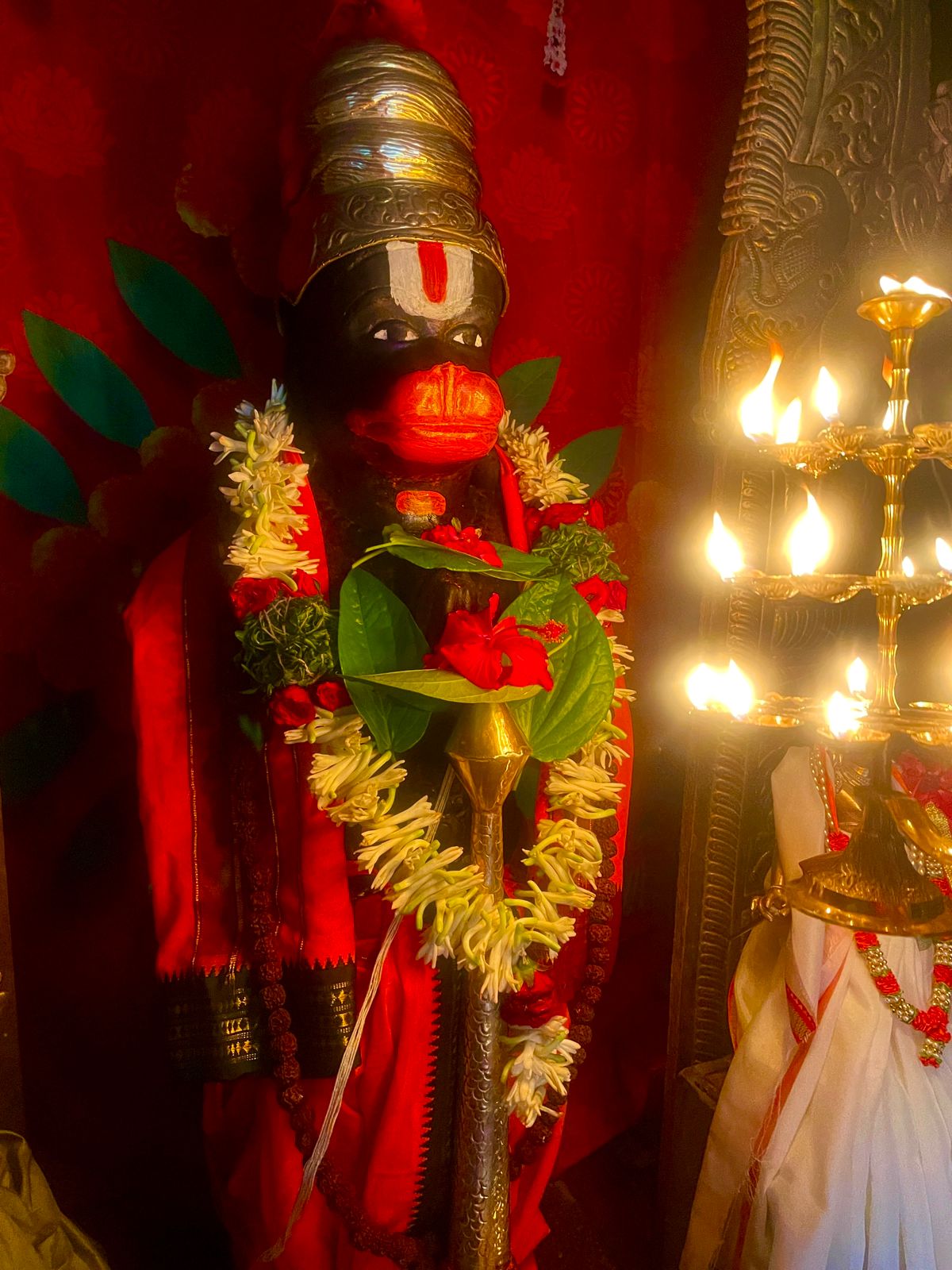
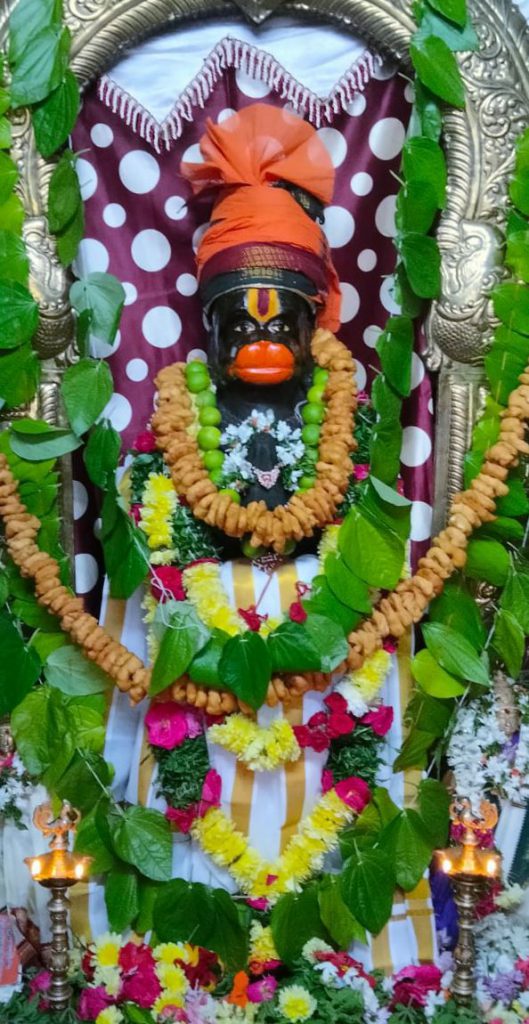
According to Hindu legends, Hanuman was born to mother Anjana and father Kesari. Hanuman is also called the son of the deity Vayu (Wind God) because of legends associated with Vayu’s role in Hanuman’s birth. One story mentioned in Eknath’s Bhavartha Ramayana (16th century CE) states that when Anjana was worshipping Vayu, the King Dasharatha of Ayodhya was also performing the ritual of Putrakameshti yagna in order to have children. As a result, he received some sacred pudding (payasam) to be shared by his three wives, leading to the births of Rama, Lakshmana, Bharata and Shatrughna. By divine ordinance, a kite snatched a fragment of that pudding and dropped it while flying over the forest where Anjana was engaged in worship. Vayu, the Hindu deity of the wind, delivered the falling pudding to the outstretched hands of Anjana, who consumed it, leading to the birth of Hanuman.
The Ramayana locates the birthplace of Hanuman in Kishkinda. Anjaneri in Nasik, Maharashtra along with Anjeneri Anjanadri (Near Hampi) in Gangavathi Taluk Koppal District, Karnataka is one of a number of places that claim to be the location of Kishkinda.
Childhood

According to Valmiki’s Ramayana, one morning in his childhood, Hanuman was hungry and saw the rising red-coloured sun. Mistaking it for ripe fruit, he leapt up to eat it. In one version of the Hindu legend, the king of gods Indra intervened and struck Hanuman with his thunderbolt. It hit Hanuman on his jaw, and he fell to the earth dead with a broken jaw. According to the Ramayana (section 4.65), Hanuman’s father Vayu (air) became upset and withdrew all the air on Earth. The lack of air created immense suffering for all living beings. This led Lord Shiva to intervene and resuscitate Hanuman, which in turn prompted Vayu to return to the living beings. As the mistake was done by the god Indra, he grants Hanuman a wish that his body would be as strong as Indra’s Vajra, and that his Vajra can also not harm him. Along with Indra other gods have also granted him wishes: the God Agni granted Hanuman a wish that fire won’t harm him; God Varuna granted a wish for Hanuman that water won’t harm him; God Vayu granted a wish for Hanuman that he will be as fast as the wind and the wind won’t harm him. Lord Brahma also granted Hanuman a wish that he can move to any place where he cannot be stopped; Lord Vishnu also grants Hanuman a weapon named “Gada”. Hence these wishes make Hanuman an immortal, who has unique powers and strength.
In another Hindu version of his childhood legend, which Lutgendorf states is likely older and also found in Jain texts such as the 8th-century Dhurtakhyana, Hanuman’s Icarus-like leap for the sun proves to be fatal and he is burnt to ashes from the sun’s heat. His ashes fall onto the earth and oceans. Gods then gather the ashes and his bones from land and, with the help of fishes, re-assemble him. They find everything except one fragment of his jawbone. His great-grandfather on his mother’s side then asks Surya to restore the child to live. Surya returns him to life, but Hanuman is left with a disfigured jaw. Hanuman is said to have spent his childhood in Kishkindha.
Sometime after this event, Hanuman begins using his supernatural powers on innocent bystanders as simple pranks, until one day he pranks a meditating sage. In fury, the sage curses Hanuman to forget the vast majority of his powers. The curse remains in effect until he is reminded of his powers in his adulthood.